Private AI Software Engineering

Software, automation, and AI systems with accelerated speed and real technical control.

I build software and AI architectures for companies that want to use AI as a productivity lever without losing data governance, security, verification, and the ability to actually ship systems to production.

AI accelerates. Systems thinking governs.

Abstract technical diagram of the Private AI Software Engineering method

Writing code is no longer the bottleneck.

AI makes it faster to generate code, prototypes, documentation, tests, and analysis. But that speed shifts the bottleneck: producing more is not enough. You have to decide what to build, how to verify it, where to run it, how to protect it, and how to ship it to production.

Speed without control becomes risk

  • Generated code is not automatically reliable software.
  • Company data cannot always leave for external services.
  • Quick demos often fall apart when they meet security, deployment, integration, and maintenance.
  • It takes technical direction to connect AI, development, infrastructure, and verification.
I don't sell generic AI expertise. I sell AI-augmented technical coordination.

Positioning

AI-augmented technical direction.

I don't replace vertical specialists and I don't sell “AI magic”. I step in when software development, infrastructure, security, data, automation, testing, and delivery have to work together.

Systems thinking at the center of software, AI, data, security, infrastructure, and operations

The exact function

Not an “AI generalist”, not a prompt engineer at the core, not a know-it-all. The value is turning a business goal into architecture, verified code, deployment, and maintenance.

  • Systems thinking
  • Clear technical boundaries
  • Human responsibility on critical choices
  • Verification before delivery

What it means

Private AI Software Engineering, in plain terms.

I build software, automation, and AI systems for companies. What changes the work is not AI itself — it is the way AI combines with engineering discipline. Three ideas govern everything you read on the rest of this page.

AI accelerates.

Generating code, analysis, documentation, and tests today takes a fraction of the time it took a few years ago. What used to take a week now happens in a conversation. This is real acceleration: production of technical artifacts at a speed manual work cannot sustain.

Systems thinking governs.

Acceleration alone shifts the bottleneck but does not remove it. Software, data, infrastructure, security, testing, and production remain parts of one system and must be designed together. Technical direction is the discipline of holding these domains together while AI accelerates each separately.

Verification makes it shippable.

Every AI output is a hypothesis until it is validated — structurally, in tests, in runtime, under load, against security constraints. Deterministic verification is the pipeline that separates probabilistic generation from release decisions and produces traceable evidence in place of trust.

Human profile with a transparent helmet and a luminous visible brain: the cognitive exoskeleton metaphor

The cognitive exoskeleton

AI amplifies human thinking. It does not replace it.

Cognitive exoskeleton: AI is worn, not delegated to. It increases the designer's capacity for analysis, synthesis, and verification — while the designer remains responsible for direction, boundaries, and critical choices.

Applied research

The same principle, from both ends of the stack.

Two technical documents published as PDFs. The hardware that holds twelve continuous hours of local inference, and the software that deterministically verifies AI-generated artifacts before release. Same method, two layers of the system.

Paper · Hardware

Notes from building a local AI inference system.

Five hardware iterations. From the first failed test (180 seconds, 90°C, shutdown) to the revision validated over 12 continuous hours. Eight GPUs at 100%, thermal range 35–52°C, zero drift. CAD design, custom aluminum, 3D-printed components.

Paper · Software

Deterministic Artifact Verification Pipelines for AI-Generated Software Systems.

Pipeline modeled as a deterministic function over the Cartesian product of artifacts and configurations. Five ordered stages, early-exit algorithm, threat model, cryptographic attestation. Validated on 100+ iterated releases, 2,446 tests across 9 blocks.

All technical material in the Lab →

Further reading

Three Lab articles that explain how I work.

Epistemology

Epistemic Software Engineering

The cost of producing software with AI goes to zero. The cost of knowing whether it is reliable does not. What changes, in practice, when the bottleneck moves from production to verification.

From generation to delivery

Speed isn't enough. A cycle is.

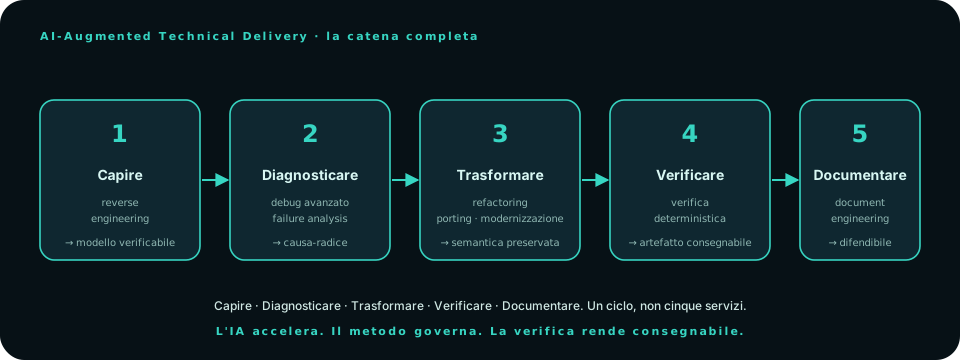
AI accelerates the production of code, text, analysis, tests and documentation. A generated output stays probabilistic until it enters a technical workflow: analysis, structure, constraints, verification, debug, review, validation. So I work on three classes of artifacts — software and automations, AI infrastructure and systems, complex technical documents — with the same principle.

The AI-Augmented Technical Delivery chain: understand, diagnose, transform, verify, document

AI accelerates. Method governs. Verification makes it shippable.

Services

What I deliver

Concrete services to bring AI into real systems, without losing technical control.

AI-assisted custom software

Design and development of custom software with controlled use of AI for analysis, prototyping, development, and testing.

Read more

RAG systems and knowledge bases

Controlled conversational interfaces for documents, procedures, manuals, contracts, tickets, and corporate knowledge bases.

Read more

Private AI and local LLMs

Architectures in which models, data, and applications sit in the right place: cloud, private, on-premise, or local.

Read more

Deterministic Verification

Technical gates that turn AI-generated or AI-accelerated artifacts into verifiable, shippable software.

Read more

DevOps, containers, Kubernetes

Docker, Kubernetes, CI/CD, hardening, logging, monitoring, and deployment to take prototypes to production.

Read more

AI technical assessment

Assessment of goals, data, risks, architecture, feasibility, costs, and minimum delivery path.

Read more

Method

From idea to verified system.

A clear path: analysis, architecture, AI-assisted prototype, verification, hardening, production, and iteration.

01

Framing

Problem, actors, constraints, data, environment, risk, and desired outcome.

02

Architecture

Pattern, stack, boundaries, cloud/local, security, and technical roadmap.

03

AI-assisted prototype

Rapid MVP to validate flows, assumptions, and operational interfaces.

04

Verification

Gates on structure, policy, tests, runtime, dependencies, and security.

05

Hardening and production

Deployment, logging, monitoring, backups, credentials, and operations documentation.

06

Iteration

Evolutionary backlog, feedback, new releases, and continuous improvement.

Analysis

Analysis becomes a project asset, not just a phase.

With AI, technical analysis stops being a preliminary step and becomes a continuous asset. Correlations, syntheses, and explorations at a depth that manual work — even with a team — cannot sustain within real project timelines.

What the analysis produces

  • Correlations across requirements, data, constraints, and dependencies
  • Rapid synthesis of documentation, technical sources, and regulations
  • Exploration of patterns and architectural alternatives
  • Mapping of assumptions, risks, and breaking points
  • Structured comparison of scenarios and operational trade-offs
Abstract diagram of the project's technical analysis: nodes, correlations, and synthesis

Not impossible by hand. Just no longer sustainable.

Knowledge Engineering

When the complexity isn't writing — it's understanding.

Technical documentation, white papers, patents, compliance dossiers. Artifacts of high cognitive complexity that turn distributed information into usable knowledge.

What I produce

  • Technical specifications and architectures
  • White papers, working papers, applied research
  • Patents and intellectual property material
  • Compliance, audit, and tender dossiers
See the full practice
Diagram of the flow from collection to structured knowledge

Workflow

Governance and quality at depths unreachable manually.

The workflows, combined with AI, bring project governance and quality assurance to levels that wouldn't be achievable by hand without automation. Not the individual tool — the workflow.

Continuous governance

  • End-to-end technical traceability across every artifact
  • Architectural and release decisions documented
  • Constant control over code, configurations, and dependencies
  • Technical project history always queryable

Extended quality assurance

  • Tests, checks, and validations replicated at every iteration
  • Coverage that manually would require dedicated teams
  • Systematic verifications where a person alone would tire out
  • Verifiable output at every step, not just at the finish line

Deterministic Verification

AI-generated code is a hypothesis. It must be verified before it becomes software.

AI generates. The pipeline verifies.

  • Structural integrity
  • Release policy
  • Automated tests
  • Runtime in container
  • Dependencies, SBOM, and CVE
  • Evidence and feedback loop
See how I verify generated software
Verification pipeline with technical gates

Private AI and local inference

Where the model runs is a data governance choice.

Private AI architecture with data source, RAG, local LLM, and access layer

Not all data can leave.

I design AI architectures where models, data, and applications are placed in the right environment: public cloud, private cloud, on-premise, or local.

  • Private RAG
  • Local LLMs
  • GPUs and dedicated servers
  • Access policies
  • Controlled environments
Read more about Private AI

Credibility

Real experience on critical systems.

Concise proof points, without turning the page into a full CV.

20+years in IT

Experience across infrastructure, security, development, DevOps, and critical systems.

AI + DevOpsfrom demo to production

Architecture, containers, Kubernetes, automation, and verification.

Private AIdata under control

RAG, local LLMs, GPUs, private cloud, and controlled environments.

6patents filed

Applied research, complex systems, and intellectual property.

Have an AI, software, or automation project to make real?

We start with a technical assessment: goal, data, constraints, environment, risk, and the minimum path to a verifiable prototype or a system in production.

Request a technical assessment